Serein guide
Short calming practices for people who care for others
Each practice takes one to five minutes and fits into a break or the walk to the car. Pick one, read the steps, and try it now.
- Breathing TideBreathing · 1–5 min
- Box BreathingBreathing · 4–12 cycles
- Here & NowGrounding · Your own pace
- Soften & ReleaseMovement · 2 min
- The Seated ResetMovement · 90 sec
- Body Scan JourneyAwareness · 2–5 min
- Full Muscle ReleaseMovement · 3–5 min
- Hand & Finger ResetMovement · 60–90 sec
- Shoulder ResetMovement · 60–90 sec
- Seated Foot & Ankle MovementMovement · 1–2 min
- Mindful ListeningAwareness · 1–3 min
- Three-Minute PauseAwareness · 3 min
- Quiet Place VisualizationVisualization · 2–5 min
- Slow Walking AwarenessMovement · 2–5 min
- Evening Wind-DownAwareness · 3–5 min
Breathing · 1–5 min
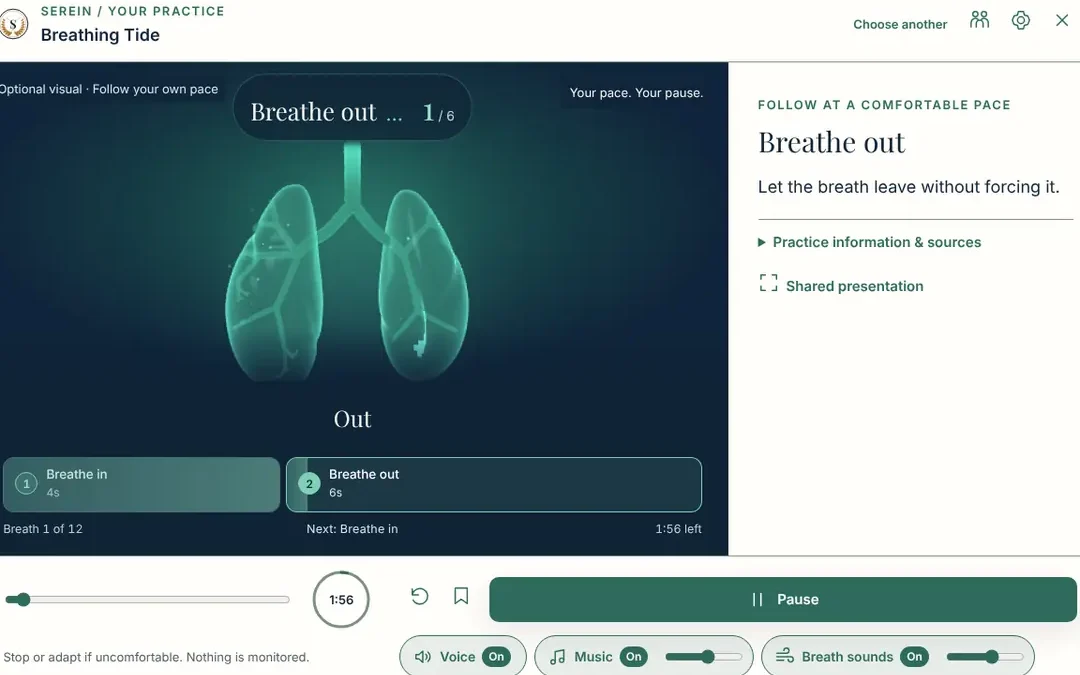
Breathing Tide
Follow a soft, expanding light. Let the next breath arrive gently.
- Breathe in. Gently, and only as far as feels comfortable.
- Breathe out. Gently, and only as far as feels comfortable.
Safety: No breath holding. The timing is optional: breathe naturally or stop if the pace feels uncomfortable or you feel dizzy.
Breathing · 4–12 cycles
Box Breathing
Follow a steady rhythm, one phase at a time. Holds are optional.
- Breathe in. Gently, and only as far as feels comfortable.
- Hold gently. Only if comfortable. No strain, no forcing.
- Breathe out. Gently, and only as far as feels comfortable.
- Rest gently. Only if comfortable. No strain, no forcing.
Safety: Never strain or force a breath hold. Choose “No holds” if holding is uncomfortable. If unsure about breath holds because of a health condition, seek advice from your clinician.
Grounding · Your own pace
Here & Now
Reconnect with your surroundings through five simple senses.
- See. Notice five things you can see. A color, a shape, the way light meets a surface.
- Feel. Notice four comfortable physical sensations. Your feet supported, the chair, your sleeve. No need to touch new objects.
- Hear. Notice three sounds around you. Nearby or far away. If hearing is not accessible, notice three visual details.
- Smell. Notice two neutral or pleasant smells. If none are available, recall familiar scents or choose two colors instead.
- Taste. Notice one taste, if comfortable. Nothing needs to go in your mouth. Alternatively, name one thing you appreciate.
Safety: Keep your eyes open if that feels safer. Skip or substitute any sense that is inaccessible, unpleasant, or uncomfortable. Nothing needs to be tasted or touched.
Movement · 2 min
Soften & Release
Notice gentle tension and release, at your own pace.
- Hands. Let your fingers soften. Notice without judging.
- Shoulders. Let your shoulders settle. There is no perfect position.
- Feet. Release the effort in your feet and lower legs.
- Rest & notice. Let your whole body be supported. Breathe naturally.
Safety: Avoid tensing painful or injured areas; choose “Relax only” or skip. Stop if you feel pain or discomfort. This is a short PMR-inspired adaptation, not a clinical protocol.
Movement · 90 sec
The Seated Reset
Ease your shoulders, uncurl your hands, and gently turn your head.
- Shoulder lift & release. Gently lift your shoulders a little, then let them lower.
- Open & soften hands. Slowly uncurl your fingers, then let your hands soften.
- Gentle neck turns. Turn left within a comfortable range, return to center, then right.
Safety: Skip any movement that is unsuitable, painful, or makes you dizzy. Do not force a stretch or roll your neck. Check with a clinician if unsure whether these movements are suitable.
Awareness · 2–5 min
Body Scan Journey
Move attention gently through supported body areas.
- Feet & support. Notice contact with the floor or chair. Nothing needs to change.
- Legs. Notice whatever is present, or choose to focus on the room instead.
- Hands. Notice the weight and temperature of your hands.
- Shoulders. Notice support. There is no need to soften on command.
- Face. Notice your expression without judging it.
- Whole body. Broaden attention, then look around the room.
Safety: Skip any area or use external focus if body attention feels uncomfortable.
Movement · 3–5 min
Full Muscle Release
Explore light effort and release across several areas.
- Hands. Optional: close your hands lightly, then let them open.
- Arms. Optional: use a little effort in the arms, then release.
- Shoulders. Optional: make a small lift, then return comfortably.
- Feet. Optional: press feet lightly into support, then release.
- Rest. No effort here. Notice the chair supporting you.
Safety: Use only light effort. Avoid painful or injured areas. Relax-only mode is available.
Movement · 60–90 sec
Hand & Finger Reset
A close-up guide to gently opening and resting your hands.
- Settle. Rest your forearms comfortably. Keep wrists neutral.
- Open gently. Gently uncurl your fingers in a comfortable range.
- Return. Return to a relaxed hand. Do not grip tightly.
- Rest. Let the hands be supported.
Safety: Stop for pain, tingling, or discomfort. This is a movement cue, not treatment.
Movement · 60–90 sec
Shoulder Reset
Follow a small lift and a gentle return to rest.
- Settle. Sit supported with arms resting comfortably.
- Small lift. If comfortable, lift shoulders a little. Keep breathing naturally.
- Return. Return gently. Avoid forcing shoulders downward.
- Rest. Notice support and stop whenever you prefer.
Safety: Use a small comfortable range. Skip painful or injured areas.
Movement · 1–2 min
Seated Foot & Ankle Movement
Explore a small up-and-down movement while seated.
- Settle. Use a stable chair. Support your leg and foot comfortably.
- Small movement. If comfortable, move the ankle gently up and down.
- Other side. Repeat on the other side only if suitable.
- Rest. Return both feet to comfortable support.
Safety: Do not force range. Skip if movement is unsuitable, painful, or causes discomfort.
Awareness · 1–3 min
Mindful Listening
Notice nearby and distant sounds without recording them.
- Arrive. Look around. Choose a comfortable position.
- Nearby. Notice a nearby sound, or a nearby visual detail.
- Further away. Notice something further away. No need to search hard.
- Whole space. Allow attention to include the room as a whole.
Safety: Use visual details if hearing is inaccessible or focusing on sound is uncomfortable. No microphone is used.
Awareness · 3 min
Three-Minute Pause
Notice, choose an anchor, then broaden awareness.
- Notice. Notice how you are arriving: thoughts, feelings, or surroundings.
- Anchor. Choose natural breathing, supported feet, or a visual detail.
- Broaden. Include the body and room. Choose one useful next step.
Safety: Breathing is optional. Keep attention external if that feels more comfortable.
Visualization · 2–5 min
Quiet Place Visualization
Explore a gentle imagined scene, with motion optional.
- Choose. Choose an ordinary place that feels comfortable enough.
- Notice. Notice imagined light, colors, or textures. You can simply view the photograph.
- Stay gently. No need to create a vivid image. Keep your eyes open if preferred.
- Return. Look around your actual room and notice its support.
Safety: Skip imagery if it feels uncomfortable. Choose grounding in your actual surroundings instead.
Movement · 2–5 min
Slow Walking Awareness
A preview of slow steps, followed by screen-away prompts.
- Prepare. Choose a clear, level space. Preview while stationary.
- Step. Put the screen away before moving. Walk at your own comfortable pace.
- Notice. Notice ordinary contact and surroundings, without changing your gait.
- Return. Stop in a stable position and return attention to the room.
Safety: Use only if walking is suitable. Do not watch or operate the screen while walking. Seated awareness is an alternative.
Awareness · 3–5 min
Evening Wind-Down
A quiet sequence of support, awareness, and optional release.
- Supported rest. Choose a comfortable supported position.
- Notice support. Notice the surface supporting you, without trying to sleep.
- Gentle release. Let hands and shoulders rest. Tensing is not required.
- Set down. Notice one thing that can wait until tomorrow.
- Finish. End here or continue resting. There is no outcome to achieve.
Safety: This practice does not treat sleep difficulties or guarantee sleep. Stop or adapt if uncomfortable.
Serein offers short calming practices. It is not a treatment and does not replace professional care. If you are struggling, talk to someone you trust or your doctor.